

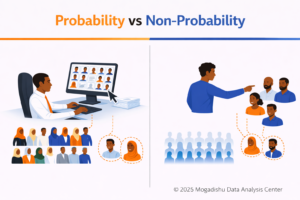
There are two primary types of sampling methods, and they are probability sampling and non-probability sampling.
Probability Sampling
probability sampling refers to the selection of a sample from a population, when this selection is based on the principle of randomization, allowing you to make strong statistical inferences about the whole group. There are four main types of probability sampling as shown below figure
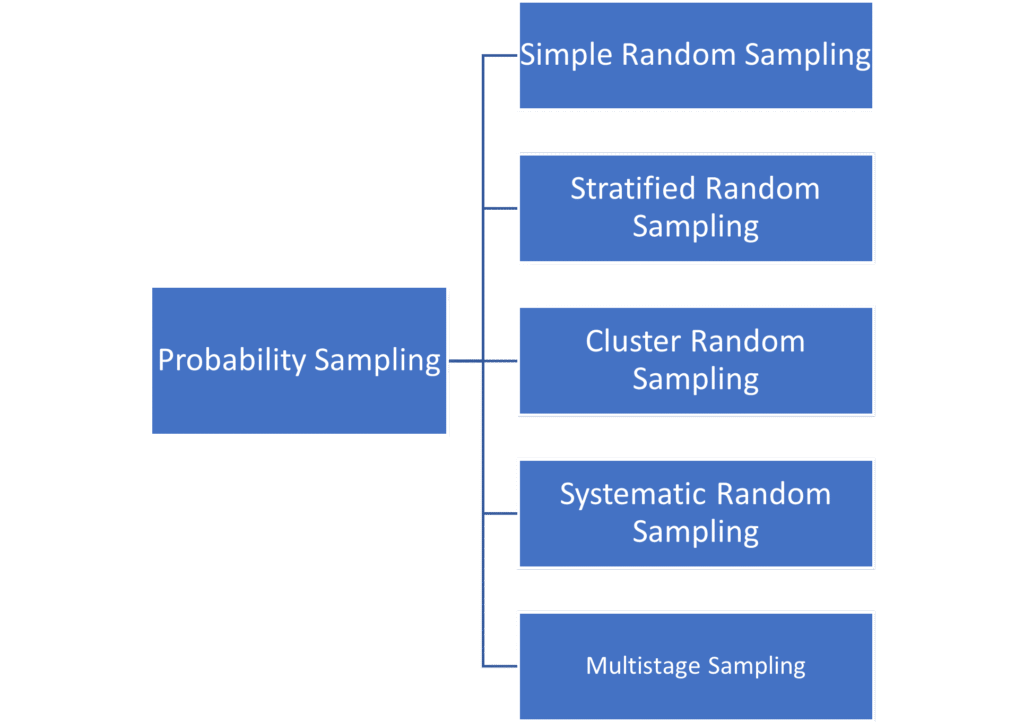
Simple Random Sampling
Simple Random Sampling (SRS), each sampling unit of a population has an equal chance of being included in the sample.
Steps of Simple Random Sampling
To select a simple random sample, follow the following instructions
- List all the elements in the population and assign them consecutive numbers. For instance, a list of a company employee is 500 as taken from HR database and assigned them to a sequence number from 1 to 500.
- Decide upon the desired sample size. Let us say 100 employees will be drawn from 500
- Use a random number generator or excel sheet to select 100 respondents.
Advantages of Simple Random Sampling
- Most basic, simple and easy method
- Provides a representative sample.
Disadvantages of Simple Random Sampling
- list of all units of the population is difficult
- numbering every unit before the sample is time consuming and expensive.
- The units need not only to be numbered but also arranged in a specified order.
- The possibility of obtaining a poor or misleading sample is always present when random selection is used
Systematic Random Sampling
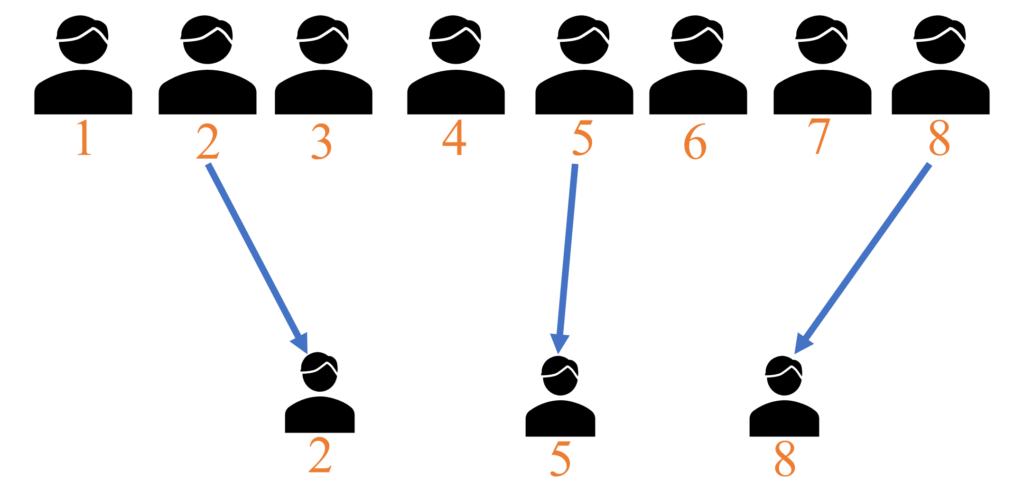
Systematic sampling is a probability sampling method in which researchers select members of the population at a regular interval (k) determined in advance. As shown below figure starting from second person, it is selected in every 2nd person
Advantages of Systematic Sampling
- It is frequently used because it is simple, direct and in- expensive.
- When a list of names or items is available, systematic sampling is often an efficient approach.
Disadvantages of Systematic Sampling
- One should not use systematic sampling in case of exploring unfamiliar areas because listing of elements is not possible
- When there is a periodic fluctuation in the characteristic under examination in relation to the order in which the items appear, the methods is ineffective
Steps of Systematic Random Sampling
- List all the population size and let N
- Decide how many people you need to sample and let n
- Divide N/n to calculate sample interval or (k)
- Start with a random individual
Example of Systematic sampling
It is drawn 5 students from 50 IT students of Jamhuriya University using systematic random sampling. All 50 students are listed in alphabetical order. 50 is divided by 5 to determine sample interval which is 10 and then it is started a starting point number which is considered number 3. From number 3 onwards, every 10th student on the list is selected (3, 13, 23, 33, and 43), and you end up with a sample of 5 students.
Stratified sampling
Stratified sampling involves dividing the population into subpopulations (strata) that may differ in important ways. The primary purpose is to increase the representatives of the sample without increasing the size of the sample on the basis of having greater knowledge of the population characteristics. Stratified random sampling method can further be sub divided into two groups which is disproportionate stratified sampling and proportionate stratified sampling. Disproportionate stratified sampling is method that all observations are drawn as equal size while proportionate stratified Sampling cases are drawn from each stratum as their proportionate size in total population.

Example of Stratified sampling
A researcher wants to know whether Hormuud company employment system reflects the gender balance of the company, so he classified the employees into two strata based on sex. Then he randomly selected on each group (50 female & 30 male) which gives a representative sample of 80 employees.
Cluster Random sampling
In cluster sampling, researchers divide a population into smaller groups known as cluster and then randomly select among these clusters to form a sample. Cluster sampling is often used to study large populations, particularly those that are widely geographically dispersed. Researchers usually use pre-existing units such as schools or cities as their clusters

Advantages of Cluster Sampling
- In cluster sampling the cost per element is greatly reduced.
- It becomes possible to take a larger sample and regain the amount of precision
- It can be used in situations where it is impossible to obtain sample by other methods
Disadvantages of Cluster Sampling
- It is a complicated sample design the researcher has to be highly skilled in sampling.
- Its standard errors are almost inevitably larger than those of sample random sampling.
Example of Cluster Sampling
A researcher developed a questionnaire to conduct an interview to determine factors affecting Somali youth unemployment. Since Somalia has 18 regions, the researcher can’t travel all the regions of the country to conduct the interview, so he decided to select randomly only 5 regions.
Multistage sampling
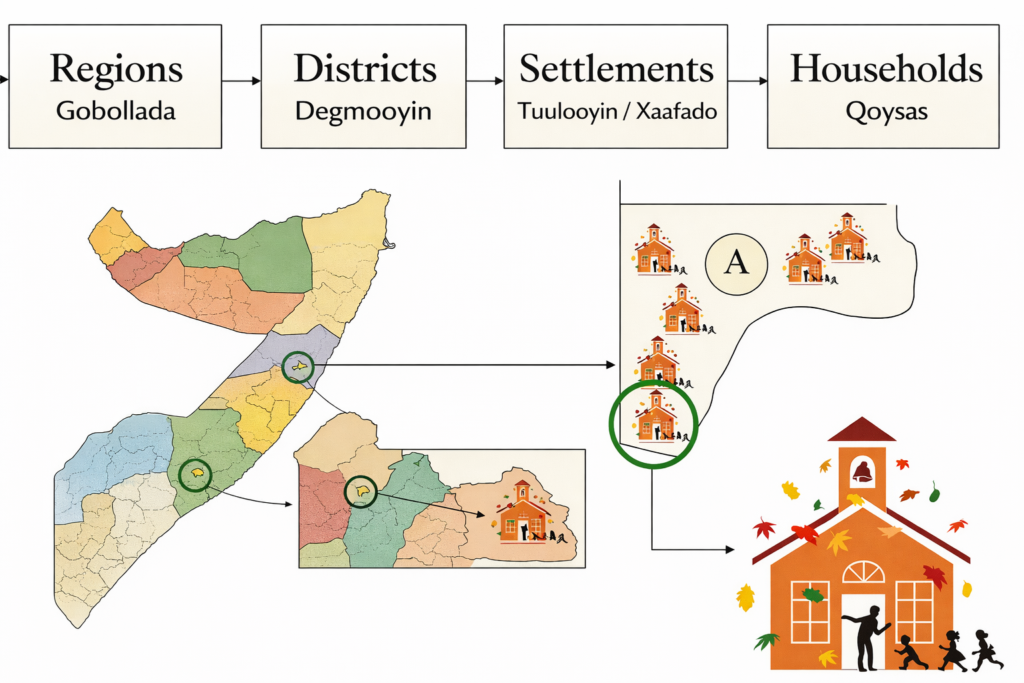
Multistage sampling involves selecting samples in multiple stages, often starting with larger clusters and increasingly sampling smaller units within those clusters. This method is very common in national surveys, like Demographic and Health Survey (DHS), Integrated Household Budget Survey (IHBS) and Multiple Indicator Cluster Survey (MICS). For example, districts are selected from eighteen regions then settlements or cities can be selected within each district and finally households are selected from the cities.
Advantages of Multistage Sampling
- Reduces cost and effort compared to sampling from the entire population directly.
- Provides a way to manage large and geographically dispersed populations.
Disadvantages of Multistage Sampling
- More complex to design and analyze.
- Potentially higher sampling error if clusters are not homogeneous
Examples extracted from SNBS
| The Somalia Integrated Household Budget Survey (SIHBS) is a nationally representative survey based on a sample of 7,212 households representative both at regional level and for urban, rural and nomadic areas at the national level. As a random sample survey, each interviewed unit (household and individual) represents a certain number of similar units in the target population. SIHBS sample of 7,212 households was selected from 601 EAs which were distributed across Somalia. About 35 EAs were sampled in each of the 17 covered regions, with 12 HHs interviewed per EA, amounting to about 420 HHs per region | Somali Household Budget survey (2022) |
| A sample size of 246 out of 2,048 IDP Camps were selected. Allocations of the sampled IDP camps were 47 camps in Beledweyne, 65 camps in Kismayo, and 67 camps each in Mogadishu and Baidoa. | Survey on Nomadic Movement into IDP Camps in Mogadishu, Kismayo, Beledweyne & Baidoa (2023) |
| 9,136 EAs formed final sampling frame of SHDS distributing 7,308 in urban and 1,828. It followed a three-stage stratified cluster sample design in urban and rural strata with a probability proportional to size, for the sampling of Primary Sampling Units (PSU) and Secondary Sampling Units (SSU) (respectively at the first and second stage), and systematic sampling of households at the third stage. | Somali Health and Demographic Survey (2020) |
Non-probability sampling
Non-probability sampling is a method of selecting units from a population using non-random method. Since non-probability sampling does not require a complete survey frame, it is a fast, easy and inexpensive way of obtaining data. That means the inferences you can make about the population are weaker than with probability samples, and your conclusions may be more limited. If you use a non-probability sample, you should still aim to make it as representative of the population as possible. This technique is often used in qualitative research
Advantages of Nonprobability Sampling
- Quick and convenient
- Inexpensive
- Reduce respondent burden
Disadvantages of Nonprobability Sampling
- Selection bias
- Noncoverage bias
- Difficulty of assessing the quality
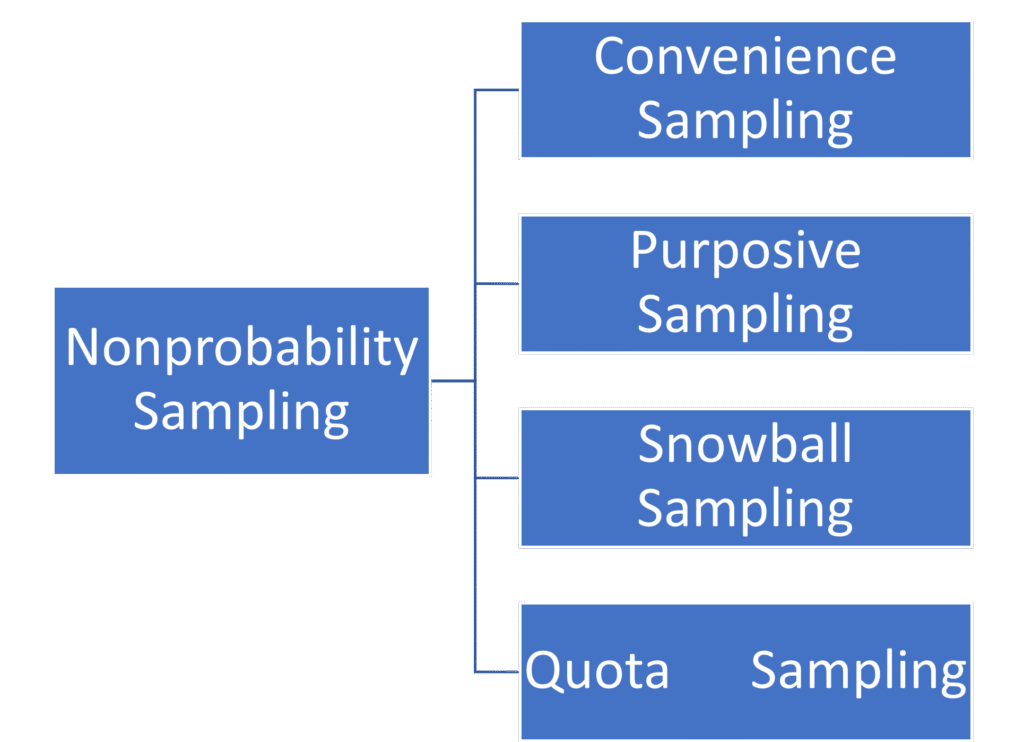
A convenience sample
A convenience sample simply includes the individuals who happen to be most accessible to the researcher. For instance, a researcher polls people as they walk by on the street.
Purposive sampling
Purposive sampling or judgement sampling, involves the researcher using their expertise to select a sample that is most useful to the purposes of the research.
It is often used in qualitative research, where the researcher wants to gain detailed knowledge about a specific phenomenon rather than make statistical inferences, or where the population is very small and specific.
snowball sampling
If the population is hard to access, snowball sampling can be used to recruit participants via other participants. The number of people you have access to “snowballs” as you get in contact with more people
Quota sampling
Quota sampling relies on the non-random selection of a predetermined number or proportion of units. This is called a quota.